When is the best time to dry the quilt
In sunny days, the best time is from 11:00 a.m. to 2:30 p.m. Want to bask in a little more, collect quilt too late, will have cold moisture invasion, dew run, counterproductive. Not all quilts can be taken to the sun, such as synthetic fiber cotton wadding should be avoided in the sun. Down quilt and wool quilt must not be taken to the sun, because the high temperature of sunlight will change the oil contained in down and wool, produce putrefaction, and also deteriorate and become brittle, becoming the breeding ground of lice bacteria.
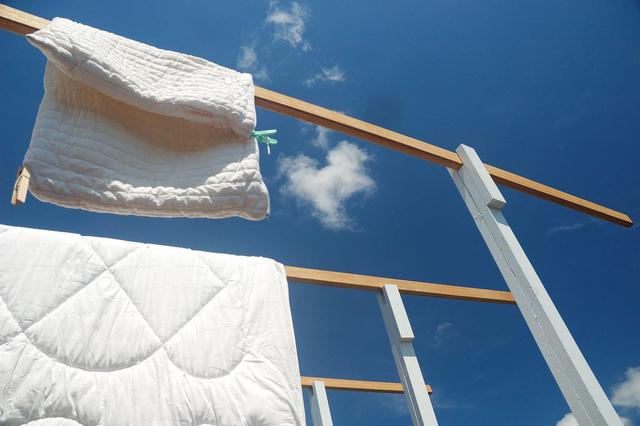
Pay attention to details: it is easy to leave some scurf and sweat in the quilt. Even if it is a clean quilt, if it is not exposed to the sun for three months, there will be millions of mites inside, and the ultraviolet ray in the sun can effectively kill bacteria.
In addition, as a variety of wood-based panels and wood furniture contain formaldehyde and other chemical substances, for a long time, the quilt inside will absorb a large amount of free formaldehyde. Therefore, choose a sunny day, take the quilt to the sun, not only can kill the harmful microorganisms in the quilt, but also can make the cotton fiber stretch fluffy, let you cover with the "sunshine flavor" soft quilt to sleep.
When drying the quilt, you should also pay attention to the following details:
First of all, quilts can be dried directly. From 11:00 a.m. to 2:00 p.m., the sun is the most abundant. During this period, the cotton fiber will expand to a certain extent. And down quilt and wool quilt do not insolate in the sun, in the balcony and other ventilation place to air for 1 hour.
Secondly, the quilt of chemical fiber fabric or mixed fiber fabric should not be exposed in the sun, because chemical fiber will release chemical substances under high temperature for a long time. This kind of quilt can be covered with a thin layer of cotton cloth before drying, which can protect the quilt surface from damage. In addition, the moisture absorption and moisture discharge of wool quilt and down quilt are very good. It is better to cover a piece of cotton cloth when drying.
Finally, do not pat a good quilt. Because the cotton fiber is thick and short, easy to break, hard beating will make the fiber into cotton dust to run out; synthetic fiber is generally thin and long, easy to deform, once the fiber is compressed after beating, it is not easy to restore and become a hardened piece; the down quilt can not be beat, otherwise the down will break into fine "feather dust", thus affecting the thermal effect. In addition, after the quilt is slapped, the dust on the surface and the excretion of mites will fly up, which is easy to cause allergic reaction. So, the quilt that basks in the sun, want to brush with brush only once, remove floating dust can.
How long does it take to dry the quilt
1. In winter, the best time is from 10 a.m. to 2.30 p.m. Want to bask in a little more, collect quilt too late, will have cold moisture invasion, dew run, counterproductive.
2. Put the quilt on the rope, and the quilt cover is inside, mainly the inside of the quilt. Sun the quilt surface more than one o'clock in the afternoon. You can collect it at four o'clock in the afternoon. You'd better pat it when you collect it. If it's dirty, you'd better have something like a stick to beat it. The purpose of drying quilt is to kill bacteria in quilt with ultraviolet ray. It's comfortable to sleep, and the quilt is often covered.
3. When basking in the quilt, in order to avoid direct sunlight, so you can cover it with a sheet, but you should turn the quilt upside down so that both sides can be evenly exposed to the sun. Kapok is exposed to the sun for three to four hours twice a week. Synthetic cotton is once a week, and it is ideal to sun it for two to three hours.
4. The wool is sun dried twice a month for two hours in the shade. Feathers are sun dried once a month, 30 minutes in summer and one hour in winter.
5. Feather quilts can also be placed on chairs indoors, as long as they can be ventilated.
6. Three changes have taken place in the quilt after being exposed to the sun: (1) the moisture in the quilt is dried; (2) the microorganisms in the quilt are killed by the ultraviolet rays in the sunlight; (3) the oxygen in the quilt is excited into ozone by ultraviolet rays. The final conclusion is that the smell of the sun is the smell of dead microorganisms mixed with ozone.